Floor Space Index (FSI): Definition, Meaning, Types & Importance in Real Estate
Floor Space Index (FSI): Definition, Meaning, Types & Importance in Real Estate
Floor Space Index (FSI), also known as Floor Area Ratio (FAR), is one of the most important concepts in real estate development and urban planning. FSI determines the maximum construction area allowed on a plot of land and plays a major role in controlling population density, infrastructure usage, and environmental sustainability.
Local municipal authorities use FSI as a regulatory tool to manage city growth while ensuring adequate water supply, electricity, road capacity, and green spaces.
What is Floor Space Index (FSI)?
FSI (Floor Space Index) is the ratio of the total built-up area of a building to the total plot area.
FSI Definition:
FSI = Total Built-up Area ÷ Plot Area
Example of FSI Calculation:
If you own a 1,000 sq. meter plot and the permitted FSI is 2.0, then the total construction allowed is:
2.0 × 1,000 = 2,000 sq. meters
This means you can build 2,000 sq. meters of total floor area across all floors combined.
FSI Full Form
FSI stands for Floor Space Index, while FAR stands for Floor Area Ratio. Both terms mean the same thing and are used interchangeably in real estate and construction.
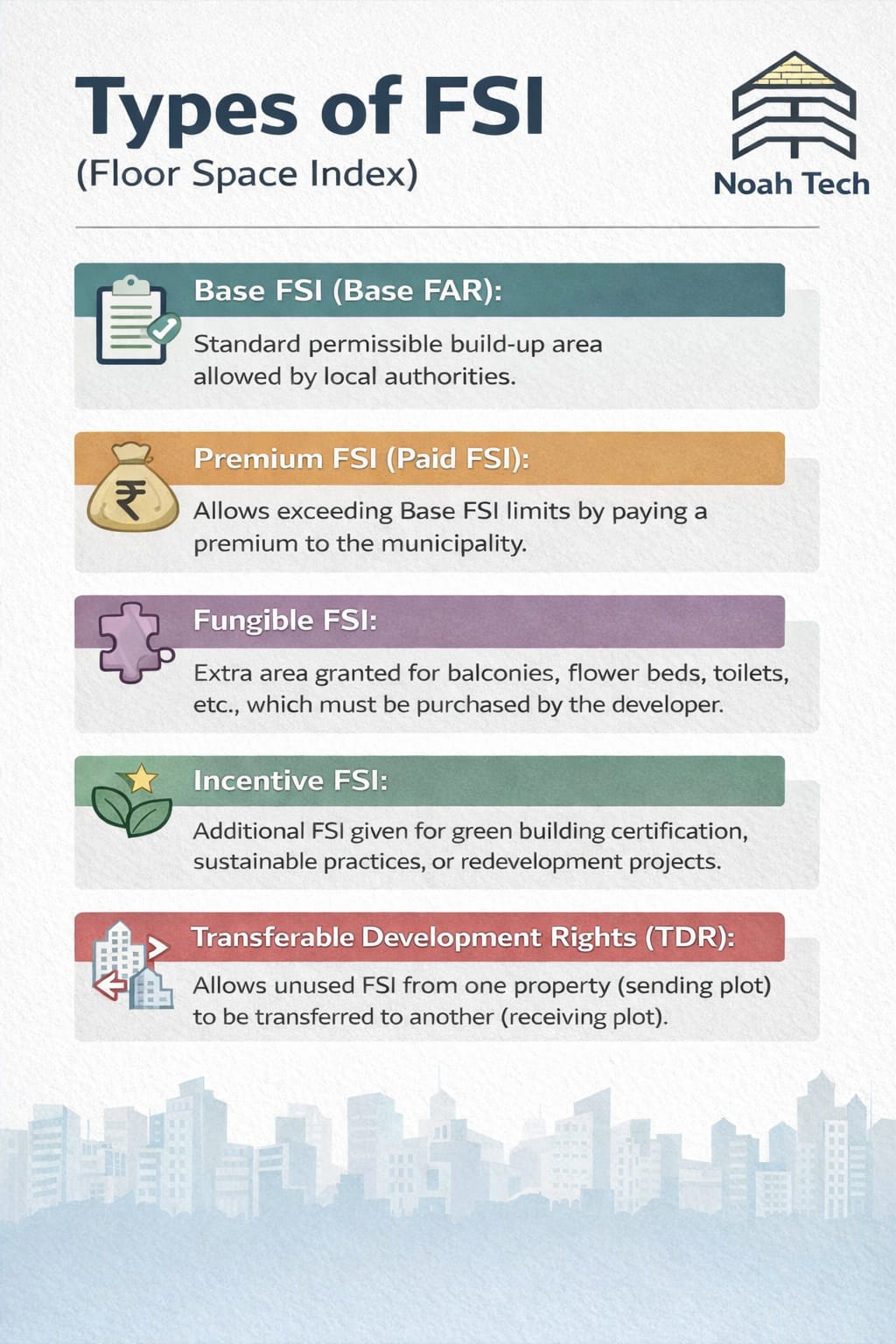
Types of FSI in Real Estate
Understanding the types of FSI helps developers and property buyers evaluate building potential and investment value.
1. Base FSI (Base FAR)
Base FSI is the standard permissible construction limit allowed by local authorities without any additional charges. It is the primary FSI allocated to a plot under development regulations.
Keyword focus: Base FSI, Base FAR meaning
2. Premium FSI (Paid FSI)
Premium FSI allows developers to construct beyond the base FSI by paying a premium fee to the municipal corporation. This is usually permitted for plots located on wider roads (30 feet or more) and in high-density zones.
Keyword focus: Premium FSI meaning, Paid FSI in real estate
3. Fungible FSI (Fungible Compensatory Area)
Fungible FSI refers to additional floor area granted by authorities for areas previously excluded from FSI calculations such as:
- Balconies
- Flower beds
- Toilets
- Passages
This extra FSI must be purchased by the developer and is widely applicable in cities like Mumbai.
Keyword focus: Fungible FSI meaning, Fungible area in construction
4. Incentive FSI
Incentive FSI is provided to developers as a reward for incorporating special features such as:
- Green building certification
- Sustainable construction practices
- Redevelopment projects
- Slum rehabilitation
- Heritage conservation
Keyword focus: Incentive FSI, Green building FSI benefits
5. Transferable Development Rights (TDR)
Transferable Development Rights (TDR) allow unused FSI from one plot (sending plot) to be transferred to another plot (receiving plot). TDR is commonly used for road widening projects, slum redevelopment, and public infrastructure development.
Keyword focus: TDR meaning, Transferable Development Rights in real estate
Factors Affecting FSI
Several factors influence the permissible FSI of a property:
- Location: Commercial zones and city centers have higher FSI than suburban areas.
- Road Width: Wider roads permit higher FSI values.
- Building Type: Commercial and mixed-use buildings generally have higher FSI than residential buildings.
- Infrastructure Availability: Areas with strong sewage systems, water supply, and electricity networks allow higher construction density.
Keyword focus: Factors affecting FSI, FSI rules in India
Importance of FSI in Real Estate
For Homebuyers
FSI indicates the density of development:
- Low FSI means more open spaces and privacy
- High FSI means high-rise buildings and crowded living environments
Understanding FSI helps buyers choose better-planned properties.
For Developers
FSI directly impacts:
- Total sellable area
- Project profitability
- Land utilization efficiency
Higher FSI increases construction potential and revenue generation.
For Urban Planners
FSI helps control:
- Overpopulation
- Traffic congestion
- Infrastructure strain
- Environmental degradation
It ensures sustainable urban growth and smart city planning.
Conclusion
Floor Space Index (FSI) is a vital parameter in real estate and urban planning that determines how much can be built on a plot of land. By understanding the FSI definition, types of FSI, FSI calculation, and importance of FAR, homebuyers, developers, and planners can make informed decisions.
Whether it is Base FSI, Premium FSI, Fungible FSI, Incentive FSI, or TDR, each type plays a ke ← Back to Blogs